Student, Master of Divinity, Princeton Theological Seminary
Master of Divinity, Princeton Theological Seminary ’28—expected
University of Pennsylvania, Post-Baccalaureate Studies ’23–’24
Bachelor of Arts, Religious Studies, Bowdoin College ’23
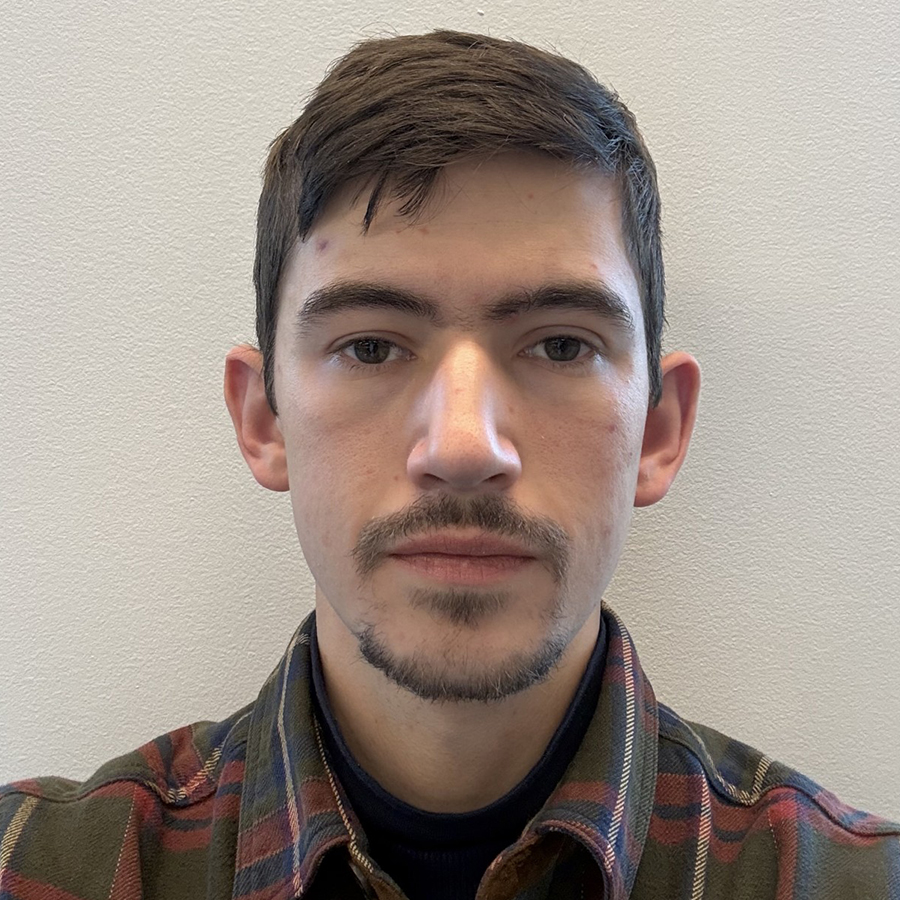
“When I was at Penn, I would never have thought that I would wind up in a Master of Divinity degree program,” begins Ethan McLear, a former Penn Post-Baccalaureate Studies program student. He enrolled in the Post-Bacc shortly after finishing his undergraduate degree, looking for clarity about his future—both in terms of a career and a discipline for graduate studies. Two semesters of advanced coursework and the network he built at Penn helped guide Ethan on his journey to a master’s program at Princeton Theological Seminary.
“I was looking for a place to continue my liberal arts education,” Ethan says about choosing Penn. Late in his college career, while majoring in religious studies, Ethan discovered an interest in philosophy. After graduating, he wanted to study the subject further. “I felt like there was just a little bit more that I had to explore,” he says. “Access to the breadth of the Penn curriculum, being able to take classes up through the 5000-level in any department, was a real draw. That and the flexibility really drew me to applying.”
“I wasn't quite sure what I was looking for while I was on campus. Having a reason to be there, having a program that placed me there, it put me in those kinds of situations where I might meet somebody and a spark might strike.”
As he perused Penn’s fall 2023 course offerings, a history course on 17th to 19th century European philosophy with Dr. Warren Breckman piqued his interest. He also enrolled in a political science course and a psychology course for his first semester.
Working part time as a math tutor in the evenings and weekends, Ethan commuted from his home in Swarthmore, PA, to campus on weekdays. “Four or five days a week, I would take the train into the city. I had my places, like in Van Pelt Library, that I liked to set up and study,” he says. “I wasn't quite sure what I was looking for while I was on campus. Having a reason to be there, having a program that placed me there, it put me in those kinds of situations where I might meet somebody and a spark might strike.”
In history and poli sci (both upper-level undergraduate courses), Ethan engaged in political and philosophical discourse, practicing how to work in harmony with people who have different points of view. He gained insight into how European thought has informed the framework of historical documents like the US Constitution and Declaration of Independence.
His psychology class, taught by Dr. Richard DiRocco, spanned from the laws of physics and the origins of life to human consciousness and human society. While Ethan had initially hesitated to add this third credit to his course load, unsure if he could manage the 5000-level graduate class, he decided the course description looked too interesting to pass up. “The lectures covered such a breadth of material and perspectives, and it was right for me at the time in my life when I met the course,” he discovered. “Maybe you’ve experienced where fireworks go off when you have a certain conversation; I found that happened during most of the lectures for the psychology course.”
For his final paper in the class, Ethan dove deep into the origins of morality and moral conflict. “It was real trust that the professor put in me to take the class in that direction, because he did not intend it to go in that particular direction.” Ethan’s research and arguments left an impression. “The professor wound up offering to team up with me for a future project that we're in the planning stages for now—probably a short book. So we've kept up both a friendship and a relationship as scholars.”
Outside the classroom, Ethan dedicated time to engaging in the Penn community. He found that simply scanning the bulletin kiosks on a stroll down Locust Walk introduced him to his choice campus extracurriculars. A highlight of his discoveries was the Red and Blue Exchange (RBX), a Penn program that promotes healthy community dialogue and debate. “I was able to attend two or three talks, and I found they were really well done, really fair, really creative in the guests they would invite to campus and how they would approach conversations,” he says.
During his second and final semester at Penn, Ethan took a class in policymaking—one possible career direction he had in mind at the time—as well as classes in education and adolescent psychology, which would help him prepare for a vocation higher on his list. “In the spring of 2024, I was seriously considering classroom teaching as my career,” he says.
The following fall, Ethan tested the waters as a full-time teacher, taking a position as a math instructor at a private school in New England. “Within a couple of months, it became clear that it wasn’t the right place for me,” he says. He left the job, once again unsure of his future. “It was a very difficult period in my life where I felt in some ways cut off, in some ways rejected, in some ways like I'd failed,” he shares.
For the next several months, Ethan returned to his search for a path forward, staying connected to his network of mentors and instructors to help guide him. “In hindsight now, there were little pieces that came together one by one,” he says. One piece of the puzzle came in the form of an email from his Penn psychology professor, Dr. DiRocco, who recommended that Ethan consider attending seminary school in Princeton.
“I didn't quite know what to make of his suggestion,” Ethan admits. As a religious studies major, Ethan had frequently been asked if he intended to continue his education at a theological seminary. “Because of what I thought seminary was, I always answered ‘no’ because I couldn't see myself as a minister or a priest, and I thought seminary was just training grounds for that vocation.” His former professor’s advice, however, encouraged Ethan to investigate the Master of Divinity program at Princeton Theological Seminary.
“I realized that the outcomes are a lot more diverse than I had imagined,” he says. In addition to becoming ordained ministers serving church congregations, graduates may go on to serve as hospital chaplains, military chaplains, or university counselors, pursue PhD studies, or work in other academic or nonprofit roles.
“Gradually, I came to realize that the things I would study in seminary were more and more like the things that had drawn me to the history course and the psychology course and the political science course at Penn,” he says.
Now in his first year of the Master of Divinity program, Ethan says he draws from his Penn classes regularly. “In theology studies and my history of the Christian Church class, I find myself confronted with discussions of various philosophical traditions that make me very glad that I got some in-depth study time with those traditions and those individuals. It was very important preparation, although I could not have known that it was serving that function in the moment.”
"The people I got to meet, the professors I got to know, they have stayed in my life, and they have been there for me in important moments when I was searching for direction.”
Next year, Ethan will explore potential vocations during his field education. “I can see two potential lines of work that my interests and gifts might lead to,” he says. He plans to complete an internship at a church as well as a clinical pastoral education (CPE) program. “You can think of CPE as similar to hospital rounds for medical students, but for spiritual and pastoral care,” he explains, noting CPE can take place at hospitals, prisons, military posts, or universities. “It’s something I feel drawn to.”
Reflecting on his year in Penn’s Post-Bacc program, Ethan shares that the impacts have endured. “In the beginning, I had very little idea where I wanted to go long term. And being able to keep exploring, keep studying, keep engaging with people throughout that year was really important, both for the intellectual piece and for the more spiritual piece,” he says. “The people I got to meet, the professors I got to know, they have stayed in my life, and they have been there for me in important moments when I was searching for direction.”
For future post-baccalaureate students, Ethan urges them to try to be intentional about their goals and in their engagement with the Penn community. “Magic can happen on campus—that chance encounter with a friend or a friend of a friend or a lecturer can really pull a lot of things together and bring a lot of clarity.”