“I've always been interested in communication. I love thinking about how we talk about things,” says Lotus Kaufman (Master of Environmental Studies ’25). She was equally passionate about the environment as she entered an undergraduate program at Penn, but she wasn’t sure if there was a pathway for her to combine her interests in climate and the humanities—academically or professionally. Then she took a class in political communication that “opened the floodgates,” in her words: “There are people who might not care about climate change, who might not see the relevance in their life. But if we can talk about it in ways that matter to them, in ways that are accessible and relevant, then we can connect with them on these issues,” she explains. “This is how I can bring communications into the environmental space.” Rather than piling on course credits for a double major, Lotus opted to submatriculate in the Master of Environmental Studies (MES) program and design the graduate degree of her dreams.
As a submatriculating student curating an individualized concentration in climate communication, Lotus worked closely with her advisors to make sure she was meeting degree requirements and creating a cohesive curriculum. “I was really open-minded about what classes could be potentially applicable, and I was lucky that my advisors were super supportive and trusted me to find classes that fit,” she recalls. Along with the core requirements for the MES degree, Lotus took courses such as The Principles of Mapping for Environmental Justice and Leading Change for Sustainability, as well as an elective course on negotiation from the Wharton School. Precisely at the intersection of her interests was a course titled Climate Change and Communication, co-taught by Kathleen Hall Jamieson (whose political communication class was so pivotal for Lotus’s trajectory) and Michael Mann, director of the Penn Center for Science, Sustainability, and the Media. “That class was just incredible,” she says. “There was so much about how we talk to people about certain issues, and how to navigate climate disinformation and conspiracy theories.” In this course, students had the opportunity to write white papers and get involved with the Society of Environmental Journalists conference, which was held at Penn during that term.
In addition to her coursework, Lotus leapt at the opportunity to connect with environmental organizations through fellowships and internships. As an undergraduate fellow of the Kleinman Center for Energy Policy, she learned about energy—and met a fellow student who founded the Penn chapter of Women of Renewable Industries and Sustainable Energy (WRISE). She was a Climate Media Intern at the YEARS Project, where she contributed to the weekly newsletters, and a Water Policy Graduate Research Fellow at the Water Center at Penn. One summer, she worked as a Policy and Government Affairs Graduate Intern as part of the World Wildlife Fund‘s BRIDGE internship program, which provides preprofessional development as well as hands-on experience working with a conservation organization. “BRIDGE is an incredible summer program that is designed for people early in their careers—equipping me with tools similar to those my friends were getting from their tech and banking internships, but for climate,” she says.
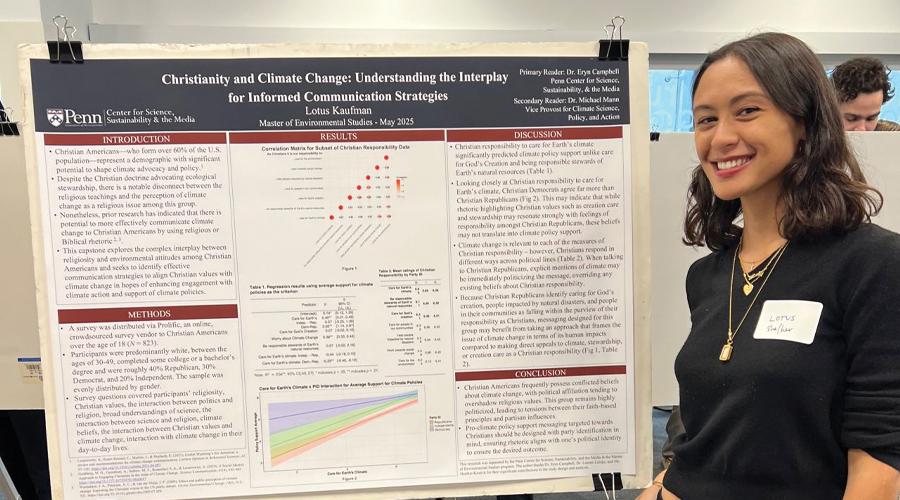
Lotus also spent a summer as the graduate research assistant for the Penn Center for Science, Sustainability, and the Media, where her work became the foundation for her capstone project. “I was really interested in the political polarization of climate change, and how you can tell someone’s stance on climate change based on political identification—at least in the United States right now,” she explains. “Then I found a book discussing how religious faith is a massive shaper of values, beliefs, and identity. I wondered if faith could be a key way to talk to people about climate issues.” Working with PCSSM’s researchers (including Associate Director Heather Kostick and climate communication expert Dr. Eryn Campbell) and reviewing contemporary research on religion and the environment, Lotus released a survey to a range of Christians across the United States. “Because we asked so many questions and got so much information, we really could have taken my capstone in any number of directions,” Lotus reflects. For her final project, Lotus focused on the concept of Christian responsibility and whether the data shows that it impacts an individual’s willingness to support climate policies; she also made recommendations for effectively communicating climate issues to this population. “It comes down to speaking to their values and their identities,” she explains.
After graduating with a bachelor’s degree in communication and her Master of Environmental Studies just one year later, Lotus is open-minded about career pathways. She can see herself eventually working for a strategic communications firm in the environmental sector or taking a role in an environmental research or policy organization—but communications specialists and environmentalists are needed in every field. “Every career is a career in climate,” says Lotus. “Now more than ever, everything is about climate change and how we adapt moving forward. And we’re going to need everybody on board for that.”