Carbon dioxide removal researcher and PhD candidate in chemical engineering
Doctor of Philosophy in Chemical and Biomolecular Engineering, University of Pennsylvania ’28 —expected
Master of Science in Applied Geosciences, University of Pennsylvania ’23
Master of International Environmental Management, Mines Paris – PSL ’23
Master of Environmental Engineering and Management, Tsinghua University ’23
Bachelor of Science in Geography and Geology, Macalester College ’21
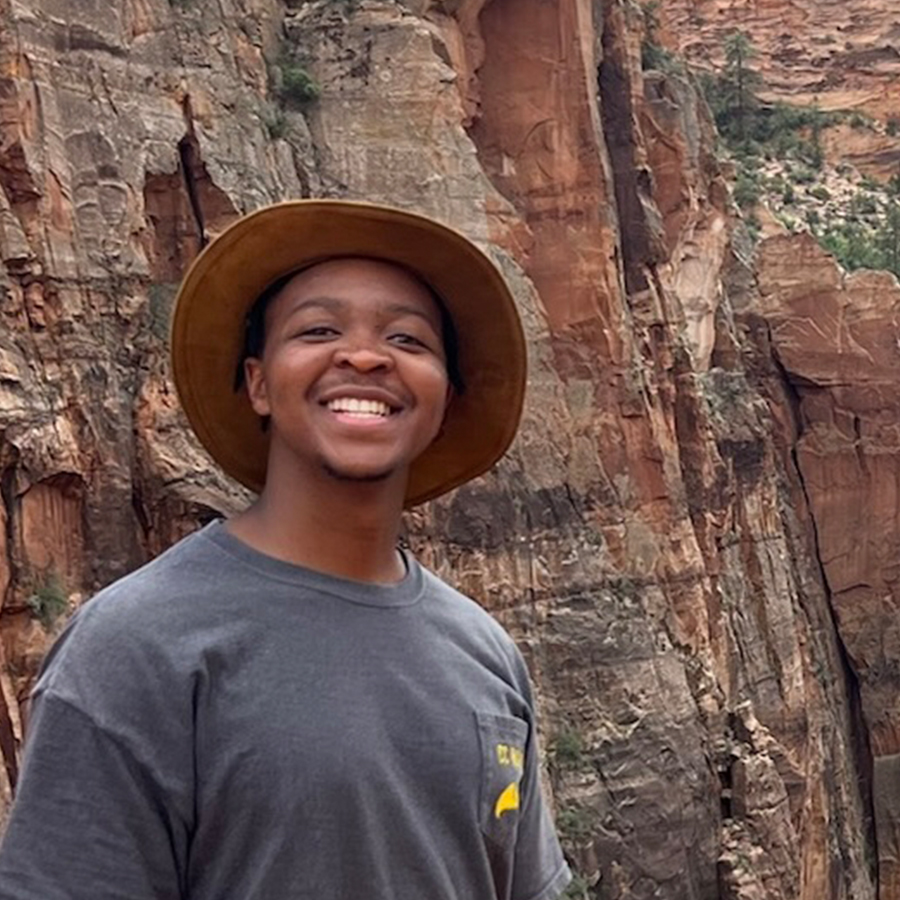
Likhwa Ndlovu (MSAG/MEng/MS ’23) fell in love with earth sciences during his undergraduate degree at Macalester College. “I found out that the classroom could be outside and in the real world,” he recalls, “and I really liked the culture within geology, where people are all about enjoying the process of learning and encouraging you to ask questions. There's so much unknown about the Earth.” After graduation, Likhwa considered whether to continue on to a PhD or jump straight into the job market. “I have always drawn my life up in multiple paths,” he explains. “I think sometimes you have to do that as an international student.” Penn’s Master of Science in Applied Geosciences (MSAG) allowed Likhwa to keep his options open—and to build a bridge for either path. “What attracted me to Penn was that the MSAG program was designed for professional students, almost creating a direct line for going into the workforce,” he says.
For example, after completing the core requirements for the degree, Likhwa spent a summer interning for an engineering and environmental consulting firm. He also had the opportunity to work as a teaching assistant for a class, which gave him pedagogical experience he hopes to build on in the future. “Teaching was awesome,” he says. “Some undergrads take intro geology because they have this deep love and desire to learn about it, and others take it because they need a science credit. So it was fun to have to teach to that balance, to bolster the interests of students who are really excited about this, but also to find personal connections to the subject for students who are just here for the ride.”
As a rare full-time MSAG student, Likhwa had an unusual opportunity to pursue three master’s degrees simultaneously in the Multi-Master’s Degree in International Environmental Management (IEM).* To complete the requirements for the multi-master’s degree, Likhwa spent one term studying with Tsinghua University in China—online, due to COVID-19 precautions. During his term at Mines Paris Tech, he was able to attend classes in France and practice speaking the language he had studied as an undergraduate. After completing a thesis project that met the standards for all three programs, he would receive a Mastère Spécialisé degree in Environmental Management and a Master of Engineering in addition to Penn’s Master of Science in Applied Geosciences.
While in Paris, Likhwa reached out to a fellow researcher who worked with the Clean Energy Conversions Laboratory at Penn, a collaboration which helped develop his master’s thesis project upon his return to the States to finish his degree. Although the Clean Energy Conversions Lab is housed in the Department of Chemical Engineering at Penn, Likhwa worked alongside two other geologists as well as chemical engineers in researching carbon dioxide removal (CDR). “What we're trying to do is take carbon dioxide out of the atmosphere, which we know we have to do if we're going to meet our climate goals,” he says. “Every conversation about carbon dioxide removal needs to emphasize reductions—we have to stop emitting as much—but we also have to remove what we’ve already emitted.” In particular, Likhwa researched geothermal energy and direct air capture, which is the process of capturing carbon dioxide (CO2) from the atmosphere and either sequestering it or turning it into products such as fuel or cement. “Direct air capture takes a lot of energy,” Likhwa explains. “CO2 is really diluted in the atmosphere, and it takes a lot of energy to separate CO2 molecules from everything else that is in the air. Ultimately, we need to make sure the energy used to capture CO2 does not emit more CO2 than it pulls down. Using renewable energy, like geothermal, helps decrease the CO2 emissions related to capturing CO2 from the atmosphere.”
On the plus side, there are parts of the western US that are rich in geothermal energy, which offers a more sustainable way to power direct air capture. Using geographic information systems and spatial mapping skills he learned during his MSAG coursework, Likhwa could help map optimal placement for direct air capture plants, and also contribute to discussions about energy, environmental, and justice-related impacts. “For example, are we taking away renewable electricity that should be used to power people's houses? And even seemingly sustainable projects, like geothermal energy, can have negative impacts—in some cases, it can affect the groundwater levels or impact different ecosystems and resources,” he says. These complex questions helped shape his capstone project, "Pairing Direct Air Capture with Geothermal Energy: Responsible Scaling in Nevada," which explored the social and environmental justice dimensions of direct air capture, as well as its associated energy requirements. His research earned him the Earth and Environmental Science Award for Excellence in Applied Geosciences at graduation. “I was and still am deeply grateful and surprised,” he says. “I think I've taken a lot of risks in terms of the projects that I have done and the places I have gone, and it was really affirming to receive the award and be viewed as part of the community and the department.”
After completing his capstone project and his triple master’s degrees, Likhwa once again found himself at a professional crossroads—not just whether to pursue an academic or industrial path, but also whether to remain in the US, accept an internship in France, or return to Zimbabwe to help build geoscience capacity in his birthplace. At no point had Likhwa imagined pursuing a PhD immediately after finishing a multi-master’s degree on the heels of his undergraduate career, let alone one in a subject that is tangentially adjacent to his studies so far. Yet, at the encouragement of the principal investigator of his lab, Likhwa applied and was accepted to a chemical engineering PhD program at Penn. “It is a big pivot. People describe PhDs as an annealing process, where you're getting hammered but you come out so much stronger on the other side,” he laughs, “and I think I'm experiencing that.” Diving into chemical engineering allows Likhwa to deepen his knowledge of why and how certain minerals absorb carbon dioxide—a vital piece of carbon removal research, and one that employs his geology background as well as his new discipline. “Geologic systems have been capturing carbon dioxide in the background for a really long time,” he explains. “We’re trying to speed up those processes, and that's where chemical engineering comes in.”
While expanding his studies and working on carbon removal offer ample challenges and motivations for the time being, Likhwa sees another crossroads in his future—and many different paths he feels prepared to take, from teaching to starting his own company to environmental consulting. “I've started to shift my mind to thinking about what's the most fulfilling thing for me,” he muses. “And I think that, in whichever direction I go, it’s to find ways to help people, share knowledge, build rich interpersonal relationships, and find fulfillment that I get to learn along the way.”
“I promised myself that I will no longer doubt the outcome,” he concludes. “I will simply trust the process.”
*Advanced MSAG students may only be eligible for the IEM multi-master’s degree if they are full-time students. This rigorous program is not ideal for students who are employed full or part time.