Former Coordinator at the Penn Women’s Center, University of Pennsylvania
Master of Philosophy in Organizational Dynamics, University of Pennsylvania ’25
Master of Science in Education, University of Pennsylvania ’95
Bachelor of Arts in English, The Ohio State University ’92
Throughout her career in higher education, Hitomi Yoshida (Master of Philosophy in Organizational Dynamics ’25) has focused on community needs, engagement, and empowerment. When she decided to return to school for a second, more advanced graduate degree, she looked for an academic opportunity that embodied a similar sense of community and collaboration. After her first class with the Penn Organizational Dynamics Programs, she knew she had found the right fit.
Hitomi launched her professional career in the nineties, after earning a Master of Science in education and intercultural communication from Penn. Among her nonprofit and higher ed experiences, she worked as a qualitative researcher at Temple University, conducting needs assessments of campus community partnerships and bridging engagement between students and immigrant and refugee communities. For the last decade, she has held various roles at Penn, serving extensively with the Division of Student Life, most recently at the Penn Women’s Center (PWC).
Her interest in returning to school, she says, started a few years ago. After building a career and raising a family, the self-described lifelong learner was ready for the next academic challenge. “I always want to keep learning and deepening my knowledge, and to find a way to apply the knowledge in a real setting,” she shares. As she explored offerings at Penn, the Master of Philosophy (MPhil) degree from Penn’s Organizational Dynamics Programs grabbed her attention. Designed for master’s degree holders interested in deepening an area of expertise, an MPhil would allow Hitomi to build on her previous graduate studies.
Eager to test the waters before committing to a degree, Hitomi initially applied to the Dynamics Learning Exchange (DLE), which offers academically qualified students with professional work experience a non-degree-seeking option to study with the program. (Successful applicants can take up to two courses with Penn Organizational Dynamics, which they can count toward a master’s degree in the program if they are later admitted.)
During her first course, Everyday Intergenerational Conversations with Drs. Alan Barstow and Amrita Subramanian, Hitomi says she was struck by the instructors’ facilitative pedagogical approach to teaching, which encouraged collaboration and active participation among students. “I felt like I could bring my experience to the class,” she explains, “and I always wanted to find a program that I could bring something to.” Further conversations with Dr. Barstow about the MPhil helped convince Hitomi to apply.
Throughout her time in the master’s program, Hitomi found a similar teaching philosophy. “The organizational dynamics instructors put the students' knowledge, expertise, and ideas at the center,” she says. “Of course, they offer their knowledge and expertise, but they let us offer ours, too, because everybody is a professional in this program—everybody has a lot to offer.”
Hitomi says her pursuit of the MPhil and her course choices were very capstone-driven. So, when she couldn’t find the right course to help her expand her research skills for her final project, she was grateful for the program team’s support in finding a solution. Hitomi’s capstone advisor, Dr. Amy Ware (who is also the program director), suggested she work with Dr. Barry Dornfeld on an independent study. “I was able to take the initiative to create my own course,” Hitomi says, “and I created a syllabus focusing on ethnographic analysis and writing.”
For the required capstone, she chose to investigate leadership partnerships at a nonprofit philanthropic organization. “I wanted to expand my engagement outside of higher ed,” she says, as well as reconnect to a sector she has experience with. Collaborating with a local private foundation that partners with nonprofits serving immigrants and refugees, Hitomi was able to document the foundation’s capacity-building efforts and synthesize the most promising practices to engage and empower the constituents they serve.
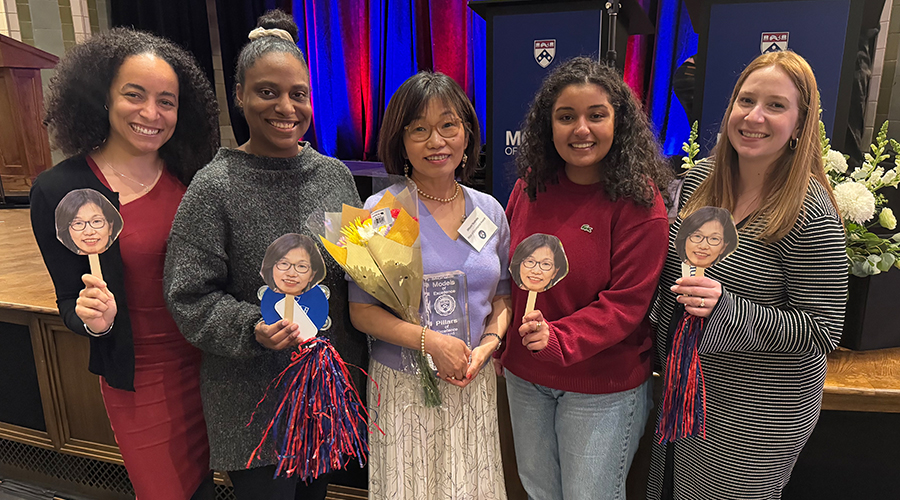
Hitomi and her Penn Women’s Center colleagues at the Models of Excellence ceremony on April 7, 2025
A few months ahead of her May 2025 graduation from the MPhil, Hitomi was honored for her service as a staff member at the PCW with a Pillars of Excellence award. “This award means so much to me in terms of how I was able to contribute to campus. I think it says something about me being a lifelong learner and contributor, and someone who is curious about people’s motivations, talents, and needs,” she says, reflecting a number of the people-focused principles central to organizational dynamics. “I found a way to engage students using their ideas and talents, bringing out who they are, as they are,” she continues. “I let the students drive, and they created amazing events and programs at the Penn Women’s Center. It's an empowerment model, and I think it is the same approach that I observed in my capstone, too.”
Now that she has finished her degree, Hitomi is taking a planned break from her professional role to take care of family in Japan. While she is unsure what her next career venture will be, she feels the Penn Organizational Dynamics experience has helped her grow and prepare to be more nimble, perceptive, and empathetic in the next stage of her life—both personally and professionally.
Hitomi compares the program experience to a quote by the 13th-century poet and Sufi mystic Rumi: When you start to walk on the way, the way appears. Rather than being prescribed a career trajectory, she says, organizational dynamics students are invited to come in with open eyes and explore. “When you step into the program, lots of discoveries unfold—about yourself, other people, society, and the organization,” she explains. “It’s all about discovery.”