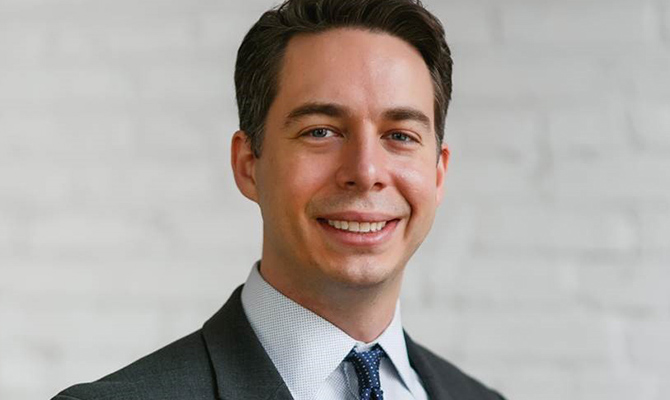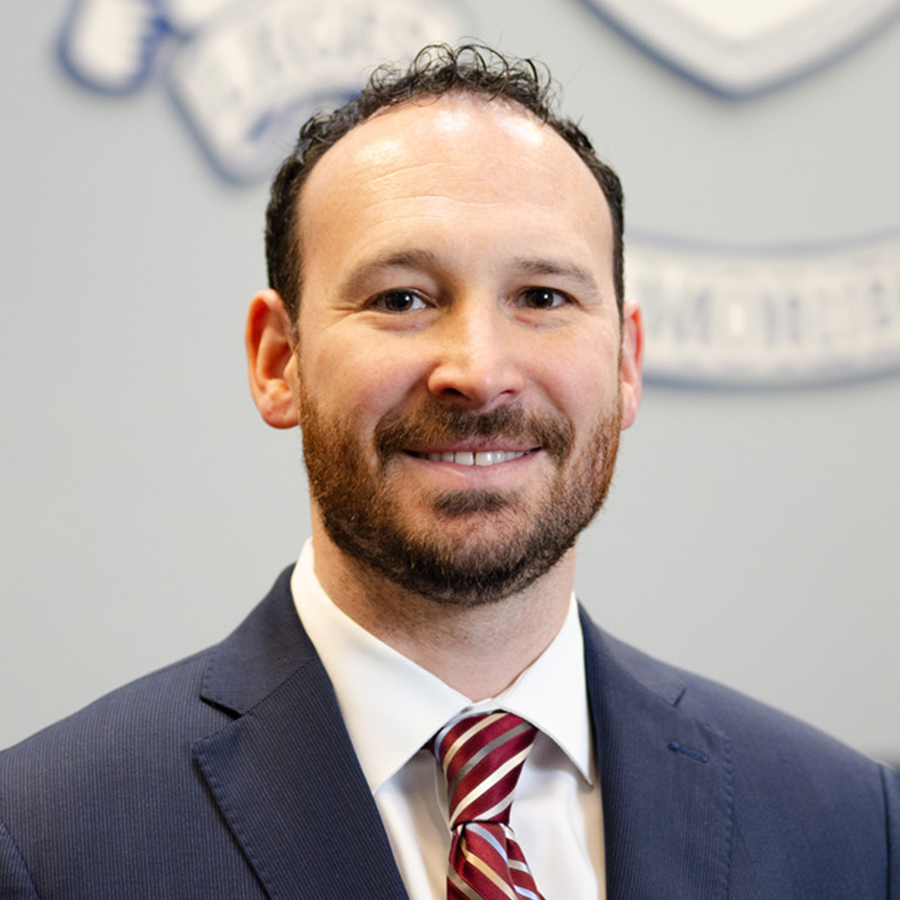
Director of Fiscal Operations, Penn Dental Medicine
Master of Science in Organizational Dynamics, University of Pennsylvania ’18
Bachelor of Science in Business Management, The Catholic University of America ’10
“My passion is finance,” says Bill Melleby (Master of Science in Organizational Dynamics ’18), currently the Director of Fiscal Operations at Penn Dental Medicine. “I like to describe finance departments as a business partner to the school, the clinic, and the researchers. We help them know how certain financial things get done, like paying lecturers, hiring new student workers, getting three different quotes to make a purchase, or seeing if there’s already a University vendor in place, things like that.” Over the years, Bill has worked with several different divisions within the University of Pennsylvania—and as a graduate of Penn’s Master of Science in Organizational Dynamics, he has a nuanced perspective on the role of finance in carrying out the University’s vision. “To bring it back to being a business partner, I think I am better suited to helping serve the mission because I experienced it myself recently,” he explains.
Bill began his Penn journey in an entry-level financial role and immediately put his tuition benefits to work; “I have always felt strongly about education,” he notes. As a recent business management graduate, he had already begun taking classes toward an MBA, but wasn’t able to transfer to an equivalent degree at Penn while working full time. “I looked into different programs, and Organizational Dynamics was the most business-related leadership program that I could complete part time—and I was able to transfer two of my MBA classes over,” he recalls. He chose a degree concentration focused on projects and program management, where he learned about different types of modeling, project plans, scope and scale, and tools like the RACI chart to clarify roles within a team. “I wish I knew about these principles earlier in my career,” he muses.
As an Organizational Dynamics Programs student, Bill took one class per term, a pace that felt balanced with his professional responsibilities for the long term—but he was still able to make the most of student opportunities such as travel. Some summer courses included a week abroad to explore strategies around the world, so Bill went to Paris to learn about complex multi-stakeholder projects from companies and government agencies, and explored strategies for surviving the 21st century by studying the culture and values of Swedish companies. “I regretted not being able to study abroad in undergrad, so when I saw these summer classes, I jumped on it,” he laughs.
Bill found that every course he took seemed to come at just the right time; for example, he studied organizational politics just as he stepped into a new role at Penn, and had weekly discussions with his peers to help him navigate the change. “I just remember that it was awesome to meet in person and talk through what we were all going through at work,” he recalls. “I was pretty novice compared to some people, and it pushed me and motivated me to sit side by side with really high-performing professionals and learn from them.” As Bill progressed through his degree, he worked his way from entry-level finance to Associate Director of Fiscal Operations for Penn Dental Medicine; from there, he advanced to Director of Finance and Administration for Penn’s Division of Public Safety. The master’s degree, he feels, helped demonstrate the dedication and expertise needed for a leadership role.
While in Public Safety, Bill had the opportunity to serve as a business partner to a new initiative: the Mental Health Co-Responder Program, an initiative to enhance the University’s response to student mental health emergencies by dispatching a mental health professional along with a Penn Police officer. The police officer could then focus on safety and security while the mental health professional could evaluate and support the student’s mental health needs. When the division was piloting the program, they had a tight window of time to hire and train hourly employees who would be available to respond as needed on nights and weekends. “We had to quickly come up with a plan and a timeline to get them in place,” he recalls. “It was a big project over a short period of time, and we had to work with a lot of stakeholders across the University. So a lot of the things I learned in the Organizational Dynamics program held true, and I was able to put them into practice—even though it was five to seven years later!”
The co-responder pilot program was successful, so the team hired a full-time program manager to supervise the program in 2024. (When Bill surveyed Penn staff about their major projects for his Organizational Dynamics Programs capstone project, he observed that when respondents reported feeling that their projects were not successful, 90% of them didn’t have a dedicated project manager.) Their efforts were recognized with a 2025 Models of Excellence Award. “The award showed that it was worth it,” says Bill. “It took a decent amount of work to figure out, but it was fulfilling and made a difference—and it is going to impact future students and help in the long term.”
Now Director of Fiscal Operations at Penn Dental Medicine, Bill continues to apply a growth mindset to his work. “What I really like about Penn Dental is that it has a little bit of everything—it has education, it has research, there are clinics, and also we have gifts and endowments,” he explains. “Those are the four major business drivers, in my opinion, and our central business office is involved with every one of those. Every day is different, and you can learn a lot every day.” Although his family life keeps him busy, he still feels connected to the Organizational Dynamics Programs and keeps an eye out for ways to stay engaged. To prospective students considering the program, he recommends diving in—but taking your time. Bill’s own steady, sustained engagement with the Organizational Dynamics Programs proved to be a throughline as his career developed. “My professional career had a lot of upward mobility, and a lot of changes within it,” he reflects, “But the constant was the program. My professors and classmates were a sounding board and source of stability throughout my career trajectory.”